
Parasite Flooding Sequence

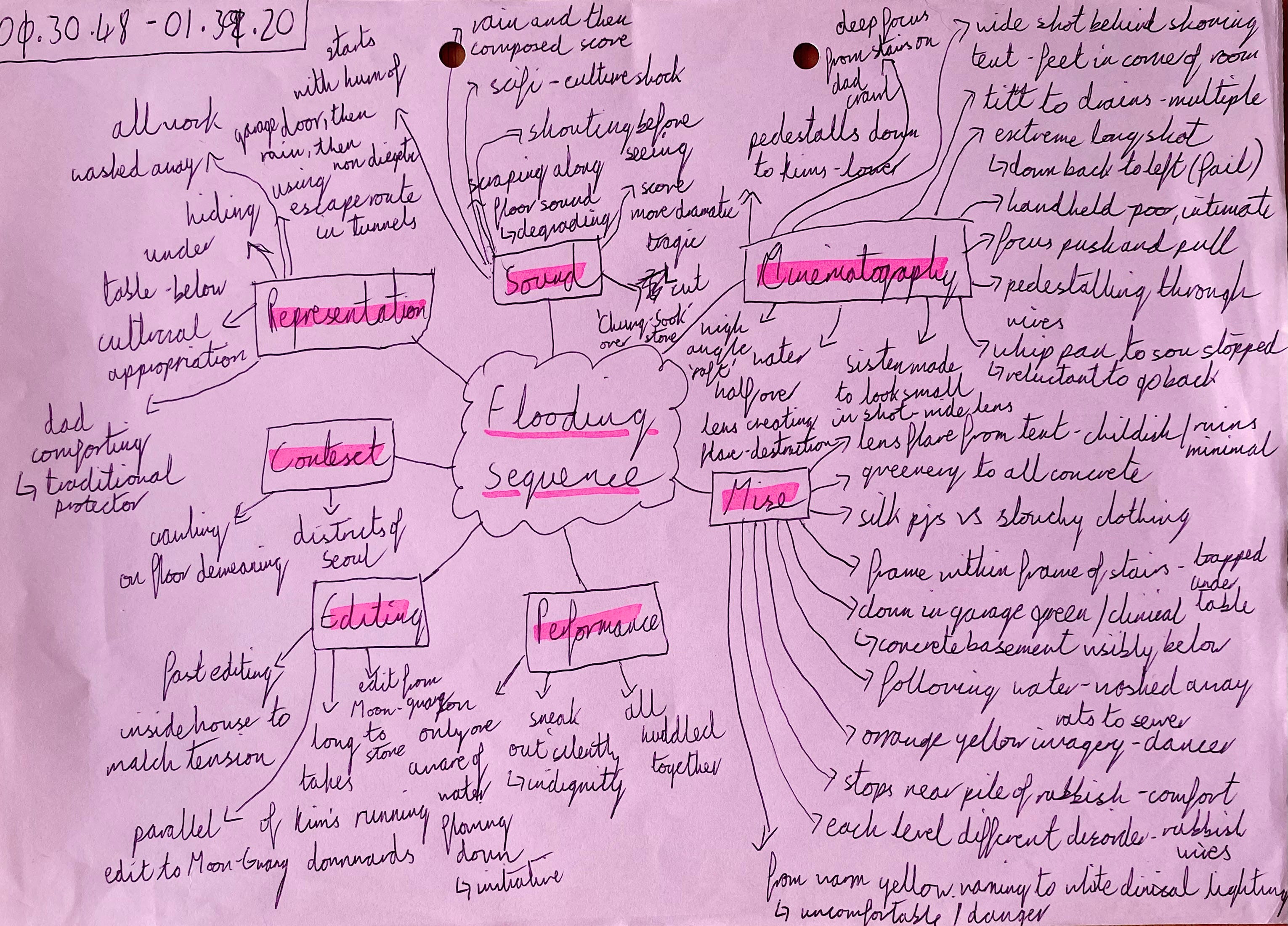
Narrative Overview
The scene starts in the lounge of the Park house- the parents woken up by their son outside in his tent. Simultaneously and unbeknownst to them, Ki-woo and Ki-jung have ran to the staircase and are hiding behind it while their father Ki-taek is mid way through sliding across the floor silently to the exit. The Kim’s escape unseen thought the garage door and run down the wealthy street, down the hill, down some stairs to the highway and down from there to a rubbish dumb under the bridge. The family take a moment to breathe, and Ki- jung is clearly distraught and regretting the lengths they had taken to infiltrate the Park family. Ki- taek consoles his daughter by telling her he has a plan, but it is clear from the red-light dump in the rain they’re taking refuge in; things are only going to get worse.
As the three of them continue on their journey vaguely downwards, Ki- woo is the first to notice the pouring rain following them. This foreshadows the next scene where we see their street completely flooded and the window to their basement flat no longer visible through the water. Ki- taek tells his kids to stay back but they all go into their ruined home to collect what they can. At the same time, there are parallel cuts to Moon- gwang (who is suffering from a concussion) and her husband. She tries desperately to remove the tape the Kim’s tied him up in but is violently sick and dies from her injury. Meanwhile, the Kim’s are still trying to save their possessions; Ki- jung smoking an old cigarette on a sewage overflowing toilet and Ki- woo transfixed by the “lucky” scholar stone. The scene ends with a Birds Eye view shot of Ki- taek pushing a makeshift raft with his son and daughter sat broken, paddling through the water.
Key Elements:
Cinematography
The cinematography in the first few shots still inside the Park’s living room are made to dehumanise and embarrass the Kim family by making them look visually small. For example, at one point the camera pedestals down from the Parks to Ki- taek crawling along the floor to mirror their class hierarchy. Then there is a deep focus shot over the shoulder showing all five characters in the shot- Ki- woo and Ki- jung are hiding behind the bannister bars, Ki- taek is crawling undetectably towards them and the Parks are looking out the window none the wiser. Then there is a wide shot from behind the couch showing the Parks centralised and their son in the tent beyond, though Ki- taek’s feet are still visible in the corner. All of these different shots and uses of wide focus are used to alienate the Kim’s in this surrounding and their humiliating situation- they are presented as the “parasites” in this scenario.
Throughout the next sequence the cinematography is mainly handheld to mimic the panic of the family, but also how unlike the clinical and “perfect” lifestyle mimicked by camera work in the Parks’ cold, soulless house, the Kims’ still have family above all else (which when taken away at the end is the final act in their failure by a capitalist society.) Anyhow, the camerawork is a lot more erratic in this part of the scene- with lots of push ins and pull outs following their movement, and then using vertical movements such as tilts to the drains overflowing as foreshadowing. This shows the chaos and desperation the Kims are facing.
There is a very interesting shot where the camera pedestals down through a jumble of phone and electricity wires as the family make their way down the penultimate flight of stairs. This stood out to me as it gave the sense that the cinematography was showing the societally hierarchy of the film (and of the world in general) through different “class” layers- each one worse than the other and ultimately leading down to the Kim family’s impoverished basement flat. In my aesthetics essay for this section of the course, I wrote that the camerawork intentionally showing “the urban disorders on the different levels and stairways” was “reminiscent of the seven circles of hell.” And for future revision reference, I also called it a “modern societal retelling of Dante’s Inferno with the Kim family at the lowest social and economic level no matter their attempts to climb higher” which is a pretty crazy but potentially useful take?
Editing
The editing in the Park’s house was much faster editing contrasted by the often wide and deep focus shots. This really helped to build up the tension as the audience was aware of the pace while also being able to see the contrast of the serene, unknowing Parks compared to Ki- taek crawling on his stomach to to get caught. By showing us a lot in a very short time, the audience is forced to empathise with the fear and anxiety of the Kims- moments away from being caught.
However, though the takes are much longer in the “descent” part of the scene the pace stays similarly fast and if anything more anxiety inducing to watch. For example, there is a wide angle long take of the Kim family running downwards with nothing else in the shot apart from the harsh concrete block stairs from the top right corner to the bottom left. The shot lingers so long we see all three of them leave it, but rather than rapid editing like in the house, the tension in this scene is created either by movement within the shot or the more unpredictable cinematography.
There are also a number of parallel edits between Moon- gwang dying of a concussion and the Kim’s having their home and possessions ruined in the flood; the last edit between them back to the scholar stone which represents the relentless curse of “success” and “luck” in a purely capitalist world (meaning basically everyone dies or has a rough time no matter their class- really cheerful Bong Joon-ho!)
Mise En Scene
The mise en scene in the beginning scene in the Park’s house is solely used to create the contrast defining the two social classes. The contrast of the highly landscaped green garden with the childish lens flare from the tent, to the bleak concrete interior of the house, the contrast of the Park’s matching silk pyjamas to the Kim’s thoughtless slouchy clothing. Then as the family escape the “minimalist” aesthetic of greenery and concrete turns slowly into their impoverished grey suburbia. These conflicting but also ironically similar aesthetics define wealth hierarchy to the audience, but also foreshadow the downfall of both families as fundamentally they are both living in a concrete prison of societies making.
Lighting is also very important in getting across the Kim families descent back to poverty. It starts off warm and cultivated in the Park’s flat but then turns clinical and purposeful in their garage- after all, drivers and housekeepers have no need for aesthetics (obviously?) This represents the Kims escape and comforts them from the “rich (in money and shade) ambient lighting in the house reflected off the heavy rain from the lush garden.” As the Kim family make their way down to their flooded Banjiah flat, the sequence is defined by its diabolical imagery reflected in the orange/red emergency lighting; clearly connoting and foreshadowing the danger and downfall to come. Then, when the Kim’s finally make it to their ruined apartment, the lighting is harsh and white- empty and emotionless.
Performance
As mentioned before, the whole purpose of the escape scene in the house is to humiliate and dehumanise the Kim family- presenting them for the first time as the real “parasites” of the story. Along with the shot layouts, Ki- taek’s performance in particular dragging himself across the floor all in all adds to this presentation.
Performance is also somewhat use in the foreshadowing of the flood, as Ki- woo often follows the camera pans down to the overflowing drains or the water running down the stairs. His awareness of this shows his initiative as the “smart one” but quiet because of his place behind his father at the head of the family (think peach scene acting.)
Sound
There is no non-diegetic sound in the opening part of this scene in the Park’s living room; this is used to highlight and heighten the tension because the audience can hear the scraping sound of Ki-taek shuffling across the floor but will the Parks also hear it? Then as the trio escape through the garage, the diegetic hum of the door opening slowly merges into the rain and then the composed sore. This creates a sense of continuity and mimics the “parasite” like movement and escape of the family.
The non diegetic composed score, contrasting the very real scenario, is a somewhat orchestral and science fiction mix. This gives a sense of the culture shock and discomfort the Kim family is now running from, and just adds to the general weirdness of the whole situation.
As Moon- gwang dies of concussion repeating “Chung- sook” frantically, there is an L cut of her recanting to the next shot of the scholar stone in the water being picked up by a transfixed Ki- woo. This use of sound not only helps the parallel edit flow more slowly, but goes back to the whole “capitalism sacrifice” ideal that runs through the film.
Context:
This scene shows the different districts of Seoul, Korea and uses them to give a heaven/hell type visual alongside the plot. There are 25 districts in Seoul split by the Han river, and the road to the Park’s house is located in the old money Seongbuk-dong area (the house itself a set) whereas the Kim’s apartment (though the flat and the street beyond were a set) is supposedly set in the working class Ahyeon-dong district.
Representation:
Age
It seems that because of his age regardless of wiseness, Ki- taek still uses his position as a father to console his children and lie t them about being able to fix everything when clearly it’s too late for that.
Culture/Ethnicity
To quote my previous essay, this scene “is the first time the Kim family are cowering away from the class they have been trying to infiltrate and imitate, and because of this delusional ambition ironically end up worse off than before the social deception.”
Gender
Similar to age, Ki- jung is presented as mildly hysterical in the fact that she’s the only one concerned enough to speak up and panic about their situation, which is quickly stopped by her father Ki- taek who uses his age and figure as the man of the house to console her.
👍
The High Sign, I think…